Google launched Nano Banana 2 today (February 26, 2026), and the short version is this: it's Gemini 3.1 Flash Image under the hood, it matches or beats Nano Banana Pro on nearly every benchmark, and it runs at Flash speed instead of Pro speed. For ad teams, that means Pro-quality image generation at significantly lower latency.
Here's the full breakdown.
What is Nano Banana 2?
Nano Banana 2 is Google DeepMind's latest image generation model. Technically, it's Gemini 3.1 Flash Image. The naming is confusing, so here's the family tree:
| Marketing name | Technical name | Status |
|---|---|---|
| Nano Banana | Gemini 2.5 Flash Image | Previous generation |
| Nano Banana Pro | Gemini 3 Pro Image | Still available for subscribers |
| Nano Banana 2 | Gemini 3.1 Flash Image | Just launched (Feb 26, 2026) |
The key shift: Nano Banana Pro ran on the larger, slower Pro model. Nano Banana 2 runs on Flash, which means it's significantly faster while pulling in Pro-level capabilities like advanced world knowledge, better text rendering, and multi-character consistency.
It's now the default image generation engine in the Gemini app, replacing Nano Banana Pro for most users. Google AI Pro and Ultra subscribers can still access Nano Banana Pro through the three-dot menu if they want it for specialized tasks.
How do the benchmarks compare?
Google published GenAI-Bench results alongside the launch. The numbers tell a clear story.
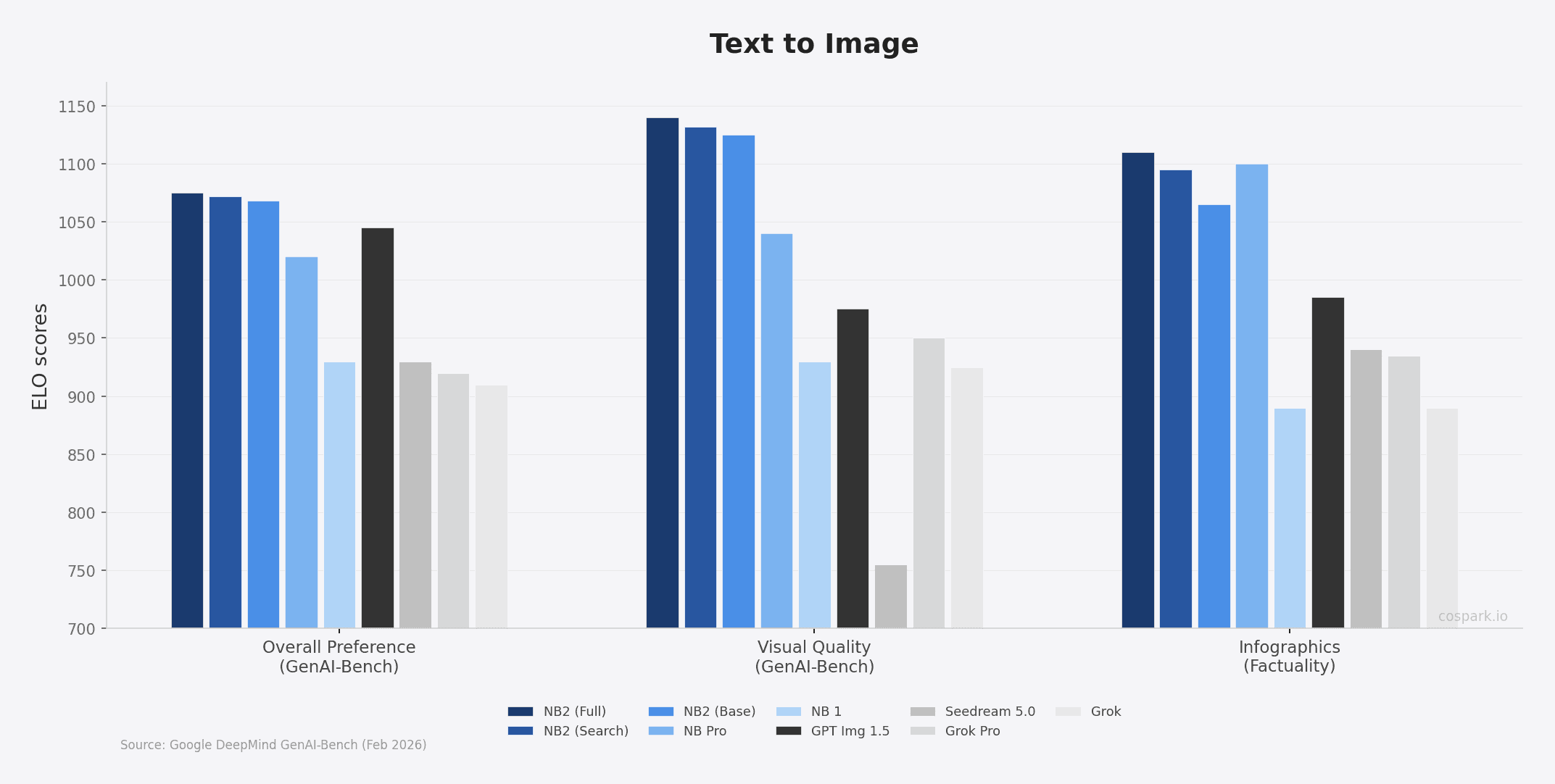
Nano Banana 2 was tested in three configurations: base model, with text and image search enabled, and with thinking + search enabled. Here's how the top-line ELO scores break down:
| Model | Overall Preference | Visual Quality | Infographics |
|---|---|---|---|
| NB2 (Thinking + Search) | ~1075 | ~1140 | ~1110 |
| NB2 (Search only) | ~1072 | ~1132 | ~1095 |
| NB2 (Base) | ~1068 | ~1125 | ~1065 |
| Nano Banana Pro | ~1020 | ~1040 | ~1100 |
| GPT-Image 1.5 | ~1045 | ~975 | ~985 |
| Seedream 5.0 Lite | ~930 | ~755 | ~940 |
| Grok Imagine Pro | ~920 | ~950 | ~935 |
A few things jump out. Nano Banana 2 beats Nano Banana Pro in overall preference and visual quality by a wide margin. Pro still holds its own on infographics/factuality (1100 vs 1065 for base NB2), but once you turn on thinking and search, NB2 takes that category too.
GPT-Image 1.5 does well on overall preference (1045) but falls behind on visual quality (975). Seedream 5.0 Lite scores a rough 755 on visual quality, which matches what most people have observed in practice. Its strength is elsewhere (multi-reference editing, built-in web search, $0.035 pricing).
The "Thinking + Text search + Image search" configuration scored highest across the board. This mode lets the model reason through the prompt before rendering and pull visual references from the web. It's slower than base NB2, but the quality jump is significant. Google lets you toggle thinking levels between Minimal (default) and High/Dynamic via the API.
What's actually new in Nano Banana 2?
Beyond the speed improvement, Google shipped several features that matter for production use:
Nano Banana 2 can pull visual references from the web during generation. Google built a demo app called "Window Seat" that generates photorealistic window views using real location data and live weather. For ad creative, this means the model can generate images grounded in real-world references without you feeding it reference photos manually.
Text rendering got a major upgrade from the original Nano Banana Flash model. Headlines, product labels, and UI text render with readable precision. The model also supports in-image localization, meaning it can translate and re-render text in multiple languages directly within the image. Google's "Global Ad Localizer" demo shows an ad being translated for international markets with both text and visuals adapted.
New aspect ratios: 4:1, 1:4, 8:1, and 1:8 join the existing options. A new 512px resolution tier was added for rapid iteration and high-volume pipelines where you don't need 4K. Instruction following is tighter, and you can configure thinking levels (Minimal vs. High/Dynamic) to control how much the model reasons before generating.
Character consistency across generations: up to 5 characters maintained with resemblance fidelity, and up to 14 objects tracked in a single workflow. Google's "Pet Passport" demo shows a pet's appearance maintained across different global destinations. For ad teams, this is useful for campaign consistency across multiple creatives.
Nano Banana 2 vs Nano Banana Pro: the direct comparison
| Feature | Nano Banana 2 | Nano Banana Pro |
|---|---|---|
| Model base | Gemini 3.1 Flash | Gemini 3 Pro |
| Speed | Flash-speed (sub-2s typical) | Slower (Pro inference) |
| Visual quality (ELO) | ~1140 (with search) | ~1040 |
| Overall preference (ELO) | ~1075 | ~1020 |
| Text rendering | Major upgrade from Flash | Strong |
| In-image localization | Yes (multi-language) | Limited |
| Character consistency | Up to 5 characters | Up to 5 characters |
| Object fidelity | Up to 14 objects | Similar |
| Thinking modes | Configurable (Minimal/High) | N/A |
| Web search grounding | Yes | No |
| Resolutions | 512px, 1K, 2K, 4K | 1K, 2K, 4K |
| New aspect ratios | 4:1, 1:4, 8:1, 1:8 | Standard ratios |
| API access | Gemini API, AI Studio, Vertex | Same |
| Pricing | $0.067 (1K), $0.101 (2K), $0.151 (4K) | $0.134 (2K), $0.24 (4K) |
| Default in Gemini app | Yes (replaces Pro) | Available via menu for subscribers |
The bottom line: Nano Banana 2 is faster, scores higher on most benchmarks, and adds web search grounding and configurable thinking. It also costs less per image ($0.067-$0.151 vs $0.134-$0.24 for Pro), so you get better results at lower cost. Nano Banana Pro's remaining advantage is niche specialized tasks where the Pro model's deeper reasoning matters, though even that gap narrows when you enable NB2's High thinking mode.
What does this mean for ad creators?
Three things stand out for anyone producing ad creative at scale.
In-image localization is a production feature, not a demo. If you're running campaigns across multiple markets, generating localized ad creatives has traditionally meant either maintaining separate asset libraries per market or manually editing text in Photoshop for each language. Nano Banana 2 handles both the translation and the visual adaptation in a single generation pass. That's a real workflow change.
The 512px tier matters for iteration speed. When you're exploring concepts and testing variations, you don't need 4K. The new 512px resolution means faster, cheaper iterations during the creative exploration phase. Generate 50 rough concepts at 512px, pick the winners, then regenerate at 4K for production. That loop is now much faster.
Configurable thinking is a dial, not a switch. Minimal thinking for batch production where speed matters. High/Dynamic thinking for hero images where quality matters. You can tune the model per-use-case within the same API, which means one integration covers both workflows.
Should you switch from Nano Banana Pro to Nano Banana 2?
For most use cases, yes. Google is making the decision for you anyway by making NB2 the default in the Gemini app.
The one scenario where Pro might still win: if you're doing complex multi-step reasoning tasks where the larger Pro model's deeper capacity makes a measurable difference. But with NB2's configurable thinking on High mode, that gap is small and shrinking.
If you're currently using the Gemini API for image generation, switching is straightforward since the model endpoint changes but the API structure stays the same.
Frequently asked questions
How much does Nano Banana 2 cost?
Google AI Studio offers a free tier with 500 requests per day and 250,000 tokens per minute. Beyond that, official API pricing is $0.067 per 1K image, $0.101 per 2K image, and $0.151 per 4K image. That's cheaper than Nano Banana Pro ($0.134 for 2K, $0.24 for 4K), and you're getting Flash speed and higher benchmark scores. Third-party providers like fal.ai may offer different rates.
What's the difference between Nano Banana 2 and Gemini 3.1 Flash Image?
They're the same model. "Nano Banana 2" is the consumer-facing marketing name. "Gemini 3.1 Flash Image" is the technical/API name. Use either interchangeably.
Can Nano Banana 2 do image editing?
Yes. It supports inpainting, outpainting, style transfer, object removal, and natural-language-based edits. This was a strength of Nano Banana Pro and NB2 inherits those capabilities at Flash speed.
How does Nano Banana 2 compare to GPT-Image 1.5?
On Google's GenAI-Bench benchmarks, NB2 scores higher on visual quality (~1140 vs ~975) and infographics (~1110 vs ~985). GPT-Image 1.5 is competitive on overall preference (~1045 vs ~1075). GPT-Image 1.5's strength is complex multi-layered prompt adherence. NB2's strengths are speed, visual quality, and the web search grounding feature.
Does Nano Banana 2 support 4K?
Yes. It supports 512px, 1K, 2K, and 4K resolutions natively. The new 512px tier is designed for rapid iteration, while 4K is for production-ready output.
Last updated: February 26, 2026